SET-ANUBIS documentation
SET-ANUBIS (Simulation, accEptance and sensiTivity studies framework for ANUBIS) is a modular framework for evaluating the sensitivity of the proposed ANUBIS detector to long-lived-particle (LLP) scenarios. It connects the model, generation and detector-analysis stages of a sensitivity study through a common set of Python interfaces.
The framework begins from a BSM model, typically supplied in Universal Feynman Output (UFO) format. It can evaluate or ingest decay widths, branching ratios and lifetimes; prepare MadGraph and optional Pythia workflows; convert HepMC events into analysis objects; model the ATLAS cavern and ANUBIS tracking stations; and apply the truth-level selection used to estimate acceptance.
Physics context
ANUBIS is a proposed transverse LLP detector at LHC Point 1. The detector concept places resistive-plate-chamber tracking stations in the ATLAS cavern and service-shaft infrastructure. This provides sensitivity to neutral LLPs that leave the main ATLAS detector before decaying into charged final states in the surrounding cavern volume.
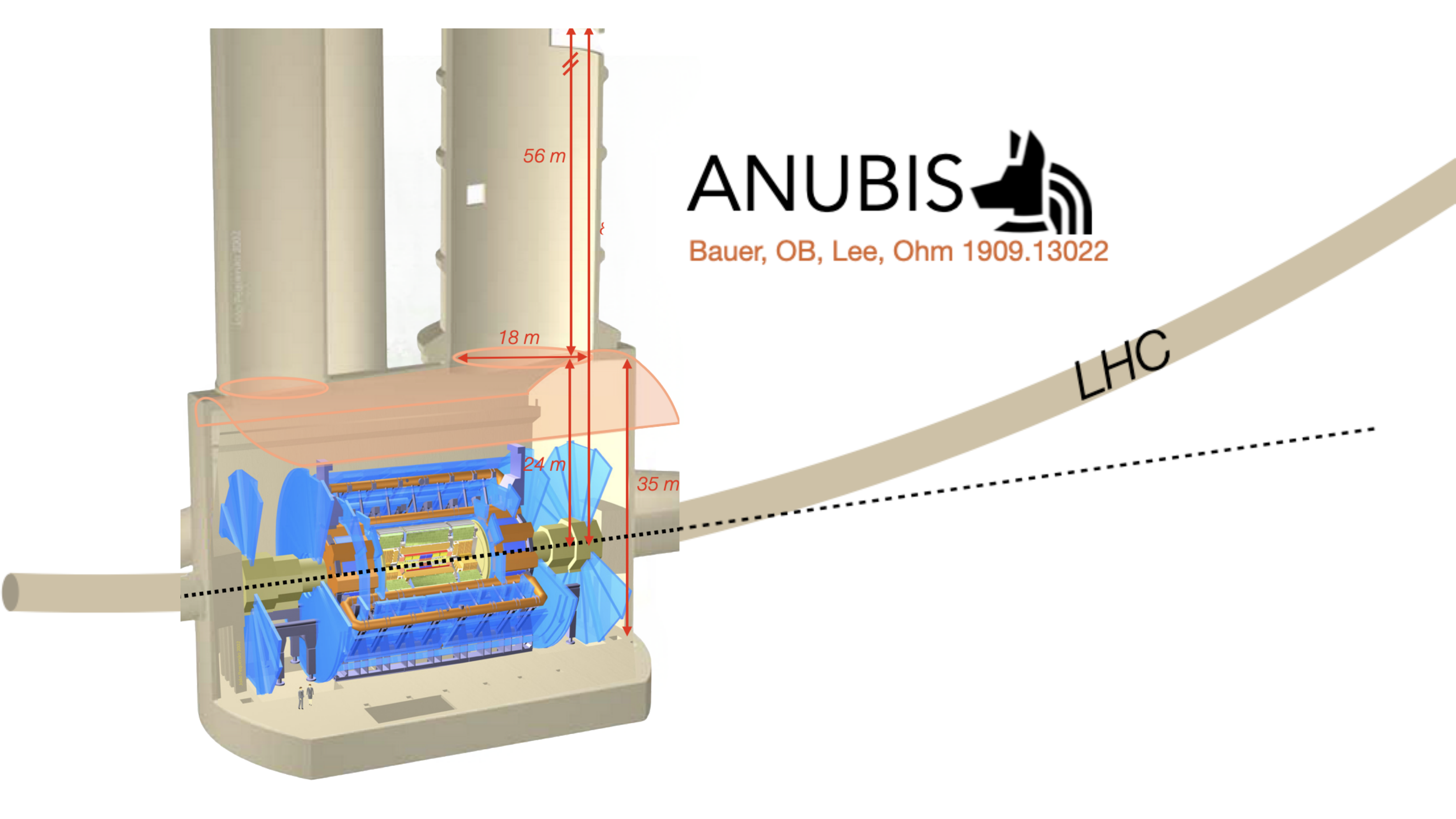
ANUBIS ceiling-detector concept and LHC Point-1 geometry, reproduced from the ANUBIS proposal (arXiv:1909.13022) under CC BY-NC-ND 4.0. The PDF page was converted to PNG without altering its content.
The purpose of SET-ANUBIS is to express this detector concept as a reproducible analysis pipeline. Model parameters, generator cards, event samples, geometry configurations and selection outputs can be related through explicit interfaces and recorded provenance.
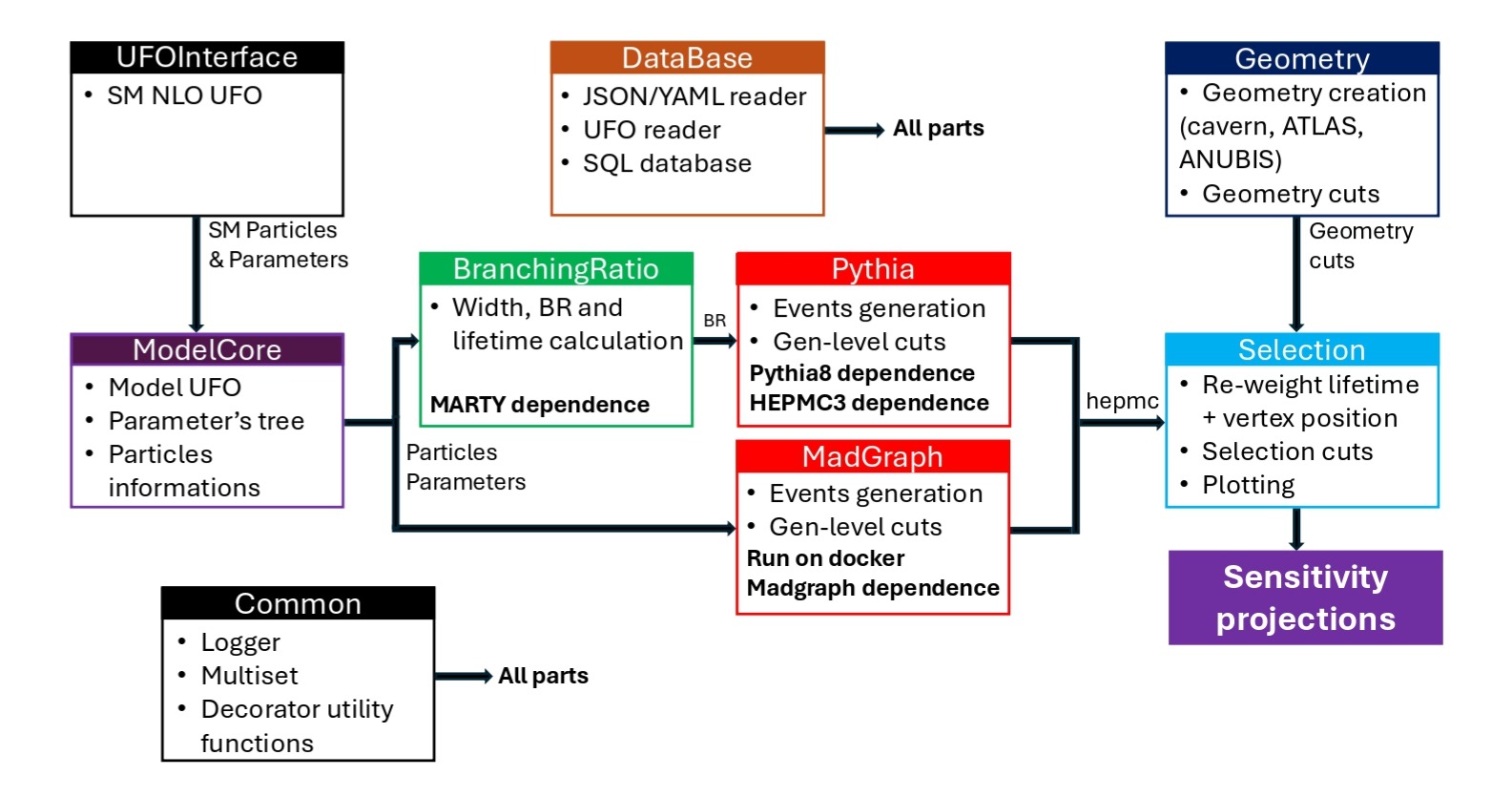
Contents
- Program overview
- Installation
- Console output and banners
- MadGraph signal generation
- Branching ratios, widths and lifetimes
- Geometry and selection workflow
- Optional Pythia support
- Interactive analysis applications
- Reproducibility protocol
- Documentation and continuous integration
- Release and publication policy
- Public short-import API
Public import layer
The Python distribution is named SetAnubis. User code should normally import
from the lower-case facade:
from setanubis import (
    SetAnubisInterface,
    MadGraphCommandConfig,
    GeneralCardInterface,
    SelectionConfig,
    SelectionPipelineBuilder,
    DecayInterface,
    CalculationDecayStrategy,
    ufo_path,
)
The internal SetAnubis.core modules remain available for framework
development, but the facade defines the documented public API and is the most
stable entry point for analyses.
Examples and interactive tools
The repository contains worked examples for the main scientific workflows:
model and UFO inspection;
branching-ratio, decay-width and lifetime calculations;
MadGraph card and scan preparation;
Pythia command-file generation;
HepMC ingestion and ANUBIS selection;
stage-by-stage selection reports using real and synthetic events.
Two optional Dash applications provide complementary visual checks. The HepMC explorer displays LLP decays and tracks in the cavern geometry, while the database dashboard audits stored runs, content-addressed artefacts and compact selection bundles.
Citation, archival and licence
Citation metadata is provided in the repository CITATION.cff file. Until the
dedicated CPC software article is available, the preferred citation is the
related ANUBIS proceedings contribution at https://arxiv.org/abs/2512.14942.
The HNL sensitivity study obtained with SET-ANUBIS is available at
https://arxiv.org/abs/2606.26862. Replace the temporary preferred citation with
the final CPC record when it becomes public.
The repository includes .zenodo.json metadata for archiving tagged releases.
After the GitHub-Zenodo integration has created the first deposit, the Zenodo
concept DOI should be added to both the README and CITATION.cff. SET-ANUBIS
is distributed under GPL-3.0-or-later.